
Ages 4–12
Brick robotics
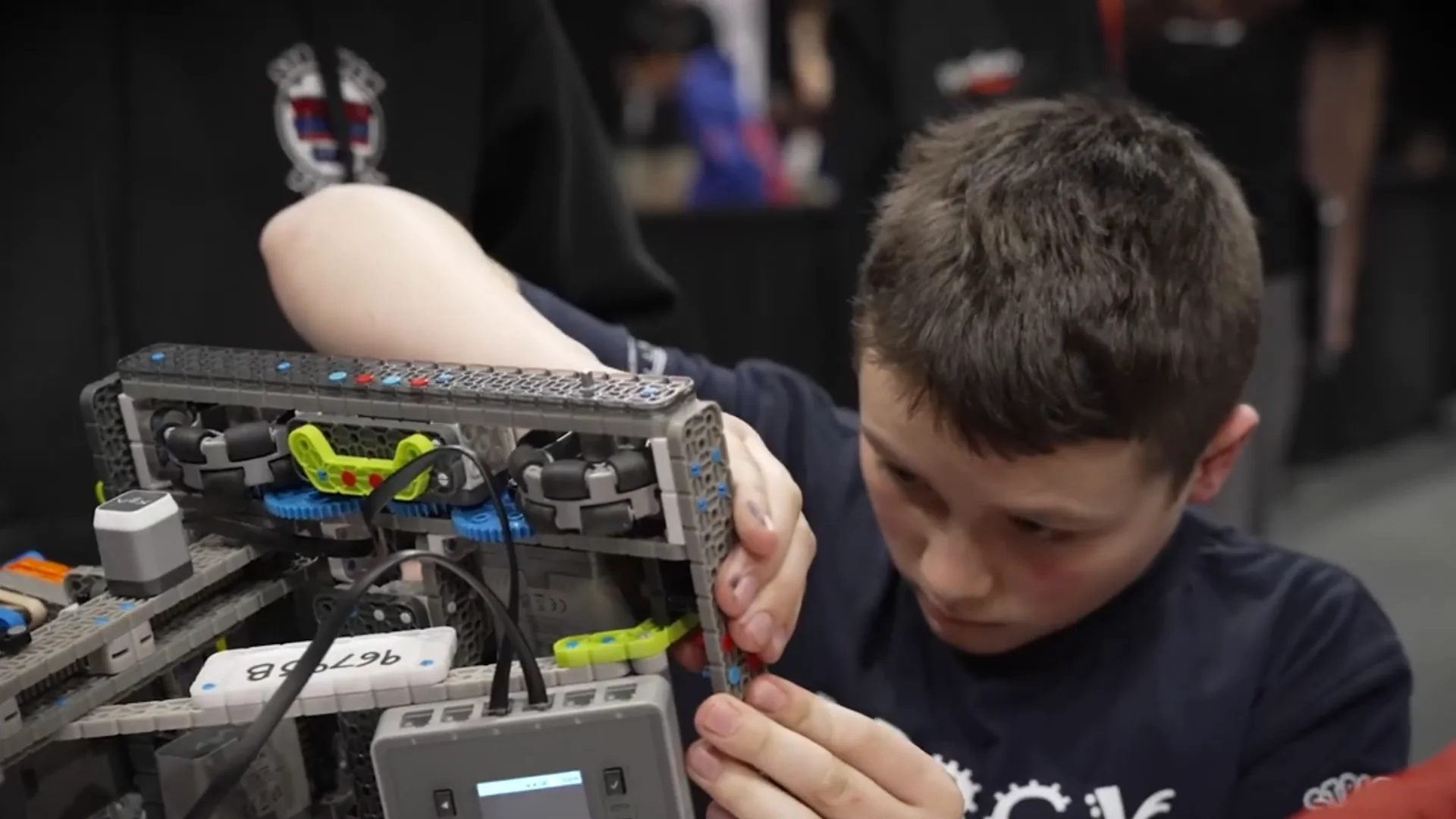
Brick models with gears and motors. Children grasp science through play and build mechanisms that move.
- Build
- Test
- Improve
Robotics here is learned by building. Children aged 4–12 assemble models with gears and motors, and students in grades IX–XII program VEX robots in C++, in partnership with ASR. Alongside robotics, pupils learn to use artificial intelligence responsibly, to stay safe online and the digital skills of ICT.
In partnership with ASR, Albanian STEM Robotic



From our classroom
Videos and photos from the robotics lesson: pupils build, program and test their models. Click to see them larger.
The course at school
Students learn by building: they assemble mechanisms, program them and test until they work. The course runs in partnership with ASR – Robotics Institute.
Ages 4–12
Brick models with gears and motors. Children grasp science through play and build mechanisms that move.
Grades IX–XII
Robots with sensors and motors, programmed in C++. Students work in teams, from an idea to a robot that completes a task.
For high-school students
What they develop
In partnership with ASR
Engineering the Future.
ASR builds a complete path from curiosity to competence: robotics, programming, artificial intelligence, cyber security and humanoid robotics, with real projects, labs and challenges.
The VEX robotics course at our school runs in partnership with ASR.
Fields
The ASR pathway
From the first mechanisms and basic logic to coding, competitions, AI and advanced automation.
4–6 years
Logic, sequences, stories and screen-free robotics to spark curiosity about technology. Children work with playful activities, simple models and their first steps in algorithmic thinking, coordination and working together in a group.
6–10 years
STEM, mechanisms, building, teamwork and testing through hands-on projects. This level introduces pupils to force, motion, gears, structures and problem solving through projects that are built and tested for real.
9–14 years
Sensors, algorithms, Blocks and Python, and challenges that link the code to how the robot behaves. Pupils move from basic commands to conditions, loops, debugging and improving performance on real tasks.
11–18 years
Engineering notebook, autonomous runs, driver skills, strategy and teamwork in a competition format. The programme is built as a full competition experience, where roles, discipline, technical documentation and decisions under pressure become part of how the pupil grows.
13–25 years
Generative AI, no-code apps, animation, 3D and data: from the prompt to a product worth presenting. The work is practical making: content, prototypes, small apps, visual presentations and the ethical use of AI in education.
14+ years
Automation, workcells, humanoid robotics, embedded systems and skills tied to industry. This level is for the most advanced pupils who want to move from educational robotics to more professional systems and scenarios close to industry.
Programmes can run as term courses, after-school clubs, labs within the timetable, camps, intensive workshops or competition teams. This lets ASR fit both institutions and individual pupils.
Every learning cycle produces something concrete: a physical model, working code, a test, a technical notebook, a presentation, a small app or a public demonstration. That makes progress visible and documented.
The path is progressive. A pupil moves to more advanced modules after showing participation, technical understanding, maturity in project work and the ability to collaborate. Institutions can build this into a plan over several years.
The technology ecosystem
ASR connects educational robotics, creative AI, cyber security and humanoid platforms in one structured path for pupils, educators and institutions.
Robotics and coding
Educational robotics from the first levels to advanced systems, with VEXcode, STEM Labs and practical challenges.
Humanoid and embodied AI
The step from coding educational robots to humanoids, simulation, SDKs and experiments with embodied AI.
AI and creative technology
Hands-on IT and generative AI workshops that turn an idea into a project: animation, apps, web, data and digital creativity.
Cyber security and networks
A curriculum reference for cyber security from kindergarten to year 12, focused on computer systems, digital citizenship and safety.
How we learn
The ASR method turns every cycle into visible proof of progress: a model, a program, a solution, a demonstration or a presentation.
How ASR works
ASR does not work as an isolated course. It organises enrolment, placement, hands-on learning, project evidence, reporting and the move to more advanced levels.
The institution or the pupil applies with basic details. Age, level, goals, technical capacity and area of interest are identified.
ASR recommends the best-fitting line: robotics, coding, AI, cyber security, humanoid robotics or a modular combination.
Groups, timetable, educator, equipment, lab rules and the goals of the learning cycle are set.
Every module moves from concept to building, coding, testing and improving. The pupil produces concrete evidence of learning.
Attendance, projects, competences, feedback and results are recorded. This builds a clear portfolio for the pupil and the institution.
At the end of the cycle a progress summary is prepared and the next step is recommended: a new module, a more advanced level, a competition team or a special project.
For schools and universities
ASR can structure the lab, the programme, educator training and the way progress is recorded.
A pathway by age group, learning objectives, projects, assessment rubrics and classroom materials.
Setting up the lab, robotics, AI and technical tools to suit the institution's capacity and level.
Onboarding, practice, classroom management, safety, teaching workflow and professional development.
Team structure, roles, engineering notebook, events, demo days and challenges that raise motivation.
A project portfolio, attendance, competences, feedback and evidence that the school and the parent can understand.
Standards, programme upkeep, updated materials and a gradual rise in the technical level.
A manageable rollout. ASR can structure the programme, the lab, groups, educator training, the calendar, reporting and activities. The institution sees participation, progress and results clearly.
A personal path of growth. The pupil enrols individually, is placed by age and level, works on practical projects and builds a portfolio. Progress is used to choose the next module or challenge.
Competences
It is a more structured way to think, create, collaborate and present solutions.
The information on ASR programmes comes from ASR's official site: asr.edu.al
Technology in class
How machines learn from data and how to use AI responsibly.
The artificial intelligence curriculum explains with simple examples how machines recognise images, sound and text.
Students try age-appropriate tools, learn to check answers and discuss the fair use of AI in learning.
Safe behaviour online: passwords, privacy and scams.
Students learn to create strong passwords, protect personal data and recognise scam messages.
Older students learn how networks work and how systems are protected from attacks.
Digital skills for learning: writing, presentations, spreadsheets and basic coding.
In ICT lessons students use the computer to write, calculate and present their work.
Step by step they move on to programming logic, which prepares them for robotics and science subjects.
Call or write to us. We will tell you the groups, the times and how to enrol in robotics.
AI assistant · online
Assistant:
Hello! I'm the Irfan Ngjeqari School assistant. I can help with admissions, programmes, transport, hours, or take you to the right page.
AI assistant, it can make mistakes. Don't share personal details. Privacy
{"you": "You", "bot": "Assistant", "typing": "The assistant is typing", "contactIntro": "For this, the school staff can help you directly:", "error": "Could not connect. Check your internet and try again.", "feedbackThanks": "Thank you! Your feedback helps us improve the assistant.", "feedbackError": "Feedback was not sent. Please try again shortly."}